Your first commercial service agreement will almost certainly be for a small building, and the mistake most residential shops make is writing it like a big one. They promise a four-hour emergency response around the clock, price the maintenance visits like residential tune-ups, and leave the scope as "maintain HVAC equipment." Six months later they're losing money on a customer who thinks they're under-delivering.
A good first commercial service agreement is narrower than you'd expect: a scope written equipment by equipment, billing terms the customer's accounts payable department can process, a response time you can staff on your worst week, and a per-site price you built from hours, not from a competitor's flyer. This post walks through each, with a worked price for a three-rooftop-unit retail site.
Who your first commercial customer really is
The commercial market looks intimidating from the outside: office towers, hospitals, chillers. That's not where most residential shops start, and the federal data shows why.
5.9 million
U.S. commercial buildings in the 2018 CBECS, with 96.4 billion square feet of floorspace
Almost half
of commercial buildings are small, 1,001 to 5,000 square feet, using only 8% of commercial energy
The 2018 Commercial Buildings Energy Consumption Survey is still the most recent full edition from the U.S. Energy Information Administration.12 Its message for a service contractor: the long tail of the commercial market is retail shops, restaurants, small offices, churches, clinics and strip centers, usually running packaged rooftop units or split systems your techs already know. The owner or a property manager is the buyer, and the deciding factors are reliability, a clear invoice and someone who answers.
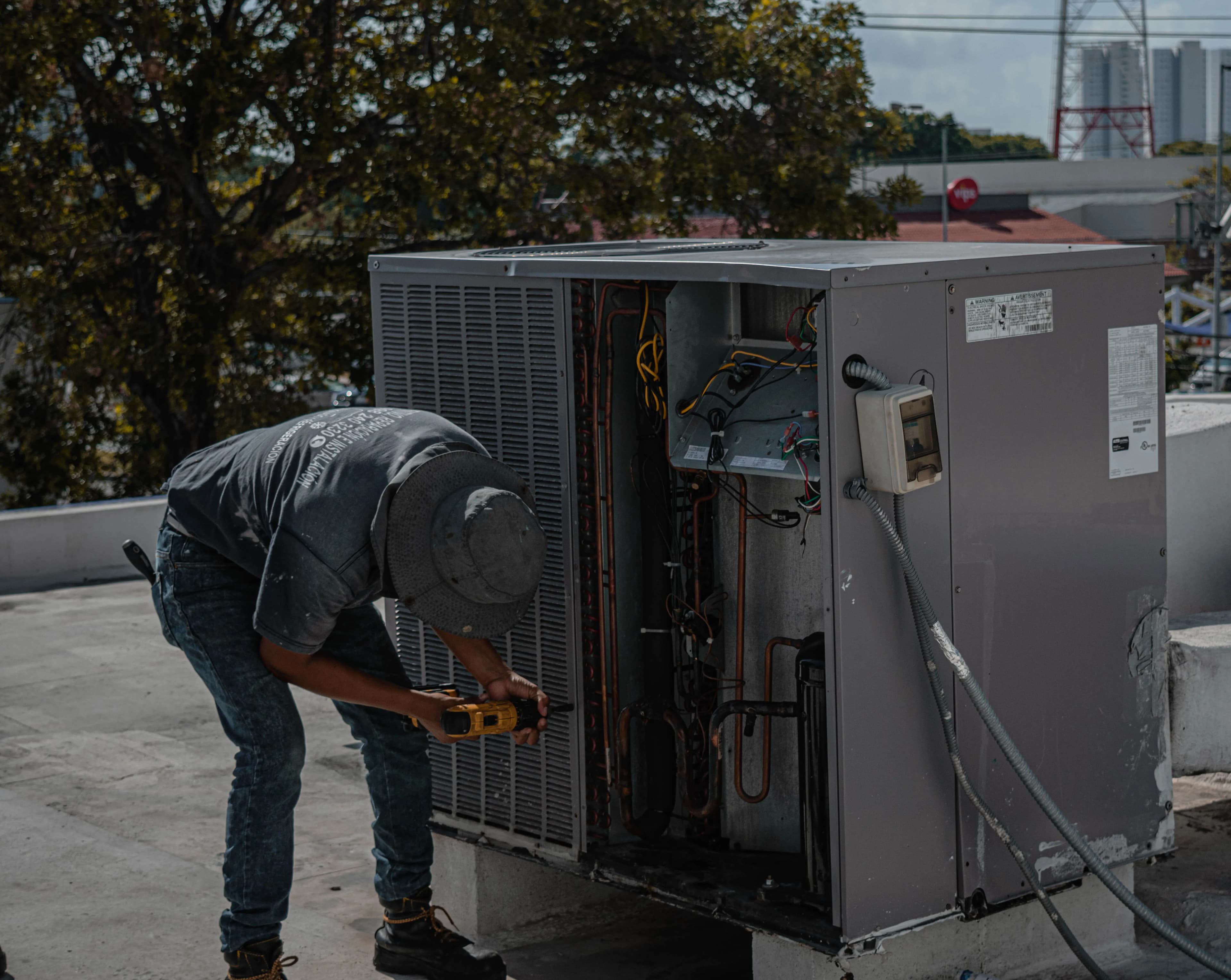
Scope: write it unit by unit
"Preventive maintenance of HVAC equipment" is not a scope. It's an argument waiting to happen. The scope should be an equipment schedule attached to the agreement, with one row per unit, and a task list per visit type.
| Field | Example | Why it matters |
|---|---|---|
| Unit ID and location | RTU-2, roof, above sales floor | Techs and the customer use the same name |
| Make, model, serial, tonnage, refrigerant | 7.5 ton, R-410A | Drives parts, labor time and refrigerant rules |
| Visit types and frequency | 2 major (spring, fall), 2 filter/belt (summer, winter) | Sets labor hours and the price |
| Tasks per visit type | See checklist below | Defines "done" |
| Consumables included | Filters (size and MERV), belts | The most common billing dispute |
| Exclusions | Repairs, refrigerant, controls programming, duct cleaning, code upgrades | Keeps repair work billable |
| Access requirements | Roof hatch key, ladder height, escort needed | Access time is real labor |
For task lists, you don't have to invent a standard. ANSI/ASHRAE/ACCA Standard 180, Standard Practice for Inspection and Maintenance of Commercial Building HVAC Systems (current edition 2018), sets minimum inspection and maintenance tasks for commercial HVAC.3 Referencing it in your agreement tells a property manager you work to a published practice, and it gives your techs a defensible checklist. Adapt it; don't paste it.
Exclusions to write down explicitly
- Repairs and replacement parts beyond listed consumables (billed under the not-to-exceed terms)
- Refrigerant, and leak repair beyond identifying the leak
- After-hours, weekend and holiday labor unless the SLA covers it
- Controls, BAS and thermostat programming beyond verifying setpoints
- Code upgrades, permits and equipment relocation
- Damage from roof leaks, tenant changes, power events or others' work
- Lift, crane or special access equipment
- Duct cleaning and IAQ products unless listed
The exclusion list feels negative to write. It's the most customer-friendly page in the agreement, because it's the page that prevents the argument.
Commercial billing terms: PO, NTE and net terms
Commercial customers don't pay like homeowners. A residential customer taps a card in the driveway. A commercial customer's accounts payable department matches your invoice to a purchase order, checks it against an approval limit, and pays on a schedule. If your paperwork doesn't fit their process, you wait.
| Term | What it means | What to put in the agreement |
|---|---|---|
| Purchase order (PO) | The customer's authorization number for the work | Whether a PO is required before work, and whether a blanket PO covers PM visits |
| Not-to-exceed (NTE) | The most you can bill on a call without new approval | A default NTE per service call, and who can approve more |
| Net terms | Days after invoice when payment is due | Net 30 is common; state it, and state late-payment terms |
| Consolidated billing | One invoice per period instead of one per visit | Many property managers prefer one monthly invoice per site or per portfolio |
| Certificate of insurance (COI) and W-9 | Proof of coverage and tax ID | Send them before the first visit; COIs often have to name the owner and manager |
| Billing contact | Who receives invoices | A named AP contact and email, separate from the site contact |
The purchase order and the NTE are the two that decide whether you get paid. The NTE in particular needs a rule that techs follow on the roof: when a repair will exceed the limit, stop, document, request approval, and don't touch it until the approval arrives. A $2,400 compressor job done on a $750 NTE without approval is a collection problem you created.
If you do federal government work, the Prompt Payment Act requires agencies to pay interest on late payments of proper invoices. The Treasury rate for July 1 to December 31, 2026 is 4.75%.4 For everyone else, late fees are whatever your agreement says, so say something.
The SLA you can keep
A service level agreement promises time. Owners get burned by not separating three different clocks:
- 1
Response
How fast you acknowledge the call and confirm a plan. This is a phone or portal promise, and it's the cheapest to keep.
- 2
Arrival (on site)
How fast a qualified tech is at the equipment. This is a staffing promise, and it's the expensive one.
- 3
Resolution
When the problem is fixed or made safe. Don't promise this; parts, access and approvals aren't in your control. Promise a status update interval instead.
Then define priority levels in the customer's terms, not yours. An example structure for a shop with one on-call tech:
| Priority | Customer definition | Response | On-site arrival | Hours covered |
|---|---|---|---|---|
| P1 Emergency | No cooling or heat in occupied space, water leak from equipment, safety issue | 30 minutes | 4 hours during business hours; next morning by 10 a.m. after hours, unless after-hours coverage is purchased | Business hours, with paid after-hours option |
| P2 Urgent | Degraded performance, one of several units down | 2 business hours | Next business day | Business hours |
| P3 Routine | Noise, minor issue, quote request | 1 business day | Within 5 business days | Business hours |
These times are an example, not an industry standard. The point is the structure, and the honest after-hours line. Before you sign anything, do this test: look at your worst week last July. If a P1 came in at 3 p.m. that Thursday, who would have gone, and what would they have left? If the answer is "nobody" or "a residential no-heat with an elderly homeowner," your SLA is too aggressive.
Pricing per site: a worked example
Everything below is a hypothetical example. Build it again with your own labor rate and times.
The site: a small retail building with three 7.5-ton rooftop units. Four visits a year: two major (spring cooling, fall heating) and two filter-and-belt visits.
Annual PM price per site
Labor hours. Count everything, not just wrench time.
| Visit type | Per-unit time | Units | Site time (check-in, roof access, report) | Drive (round trip) | Hours per visit | Visits | Hours per year |
|---|---|---|---|---|---|---|---|
| Major PM | 1.25 h | 3 | 0.75 h | 0.75 h | 5.25 h | 2 | 10.5 h |
| Filter and belt | 0.5 h | 3 | 0.75 h | 0.75 h | 3.0 h | 2 | 6.0 h |
| Total | 16.5 h |
Labor price. At a hypothetical billable rate of $145 an hour, 16.5 hours is $2,392.50. Your rate should come from your own costs; the labor rate calculator does that math. For a sense of the floor: BLS put total compensation for private-industry installation, maintenance and repair workers at $49.01 an hour in June 2026, $33.61 in wages and $15.41 in benefits, before trucks, tools or overhead.5 Sixteen and a half hours at that cost is about $809 of direct labor.
Consumables. Filters at $40 per unit per visit (3 units × 4 visits = $480 cost) and belts at $25 per unit on major visits (3 × 2 = $150 cost). At a 1.5 markup, that's $945.
SLA allowance. If this agreement includes after-hours P1 coverage, add a share of your on-call cost. At $15,600 a year spread over, say, 12 commercial accounts, that's $1,300 per site. Without after-hours coverage, it's zero, and after-hours calls are billed at your after-hours rate.
Worked example with assumed times, rates and costs. Business-hours-only price: about $3,338 a year; with after-hours P1 coverage: about $4,638.
| Labor | $2,393 |
|---|---|
| Consumables | $945 |
| After-hours SLA share | $1,300 |
So the same building is roughly $3,340 a year with business-hours response, or $4,640 with after-hours arrival. Quote both. Many small-building owners pick the lower one once they see the difference, and the ones who pick the higher one are paying for what it costs you.
Two more pricing rules that save first-timers:
- Price per site, not per portfolio. A property manager with eight sites will ask for one price. Build it from eight site prices so you know which sites lose money (usually the one with a two-story roof hatch and no ladder).
- Write in a renewal uplift. A fixed annual increase in the agreement, say 3% to 5%, beats renegotiating every year. Labor costs rise whether or not you ask.
What to look for in your software before you sign
Commercial work breaks residential workflows in specific places. Before the first PM visit, check that your system can:
Commercial readiness check
- Hold several sites under one customer, with a billing contact separate from site contacts
- Require a PO before invoicing, per customer
- Enforce a not-to-exceed limit on the invoice, and show the tech what's left
- Set net terms per customer
- Generate PM visits from an agreement and an equipment list
- Consolidate a month of visits into one invoice per customer
- Track response time against the SLA on each job
- Attach the equipment schedule and per-visit checklists to the job
In TradesWork, multi-location and commercial covers most of that list: per-customer PO required, a default not-to-exceed that an invoice can't pass without a recorded approval, net terms from 0 to 180 days, billing contacts, and multi-site service agreements with PM visit plans, covered equipment, SLA response hours, auto-renew and a renewal uplift. Visits become jobs 21 days ahead and billing consolidates to one invoice per customer per month. Honest limits: SLA tracking is a countdown on the job, not a rules engine that escalates on its own, PO blocking is off by default, and there's no ServiceChannel work-order connection or multi-property customer portal yet. If your first account requires a portal like that, plan for the double entry.
For the residential side of agreements, our maintenance agreement template and the HVAC maintenance plans guide cover membership-style plans. If your commercial work leans to kitchens or refrigeration, see the commercial kitchen and mechanical industry pages.
Free download · WordMaintenance Agreement TemplateA plain-English membership agreement you can edit, plus a one-page plan sheet for your techs to hand over.A one-page checklist before you sign
Before the first commercial signature
- Equipment schedule attached, unit by unit, verified on a site walk
- Task list per visit type, referencing Standard 180 where it fits
- Exclusions written out, especially refrigerant and after-hours
- PO process, default NTE and approval contact agreed
- Net terms, late terms and invoice format agreed with AP
- COI and W-9 sent; insurance minimums checked against your policy
- SLA with separate response and arrival times, by priority
- After-hours coverage priced as an option, not assumed
- Per-site price built from hours, consumables and SLA share
- Renewal date, auto-renew terms and annual uplift in writing
General information, not legal advice. Have your attorney review commercial agreement language, especially indemnity, insurance and lien provisions, which vary by state.
Footnotes
-
Commercial Buildings Energy Consumption Survey (CBECS), U.S. Energy Information Administration, accessed October 2026. ↩
-
2018 CBECS Consumption and Expenditures Highlights, U.S. Energy Information Administration. ↩
-
Read-only versions of ASHRAE standards: Standard 180-2018, Standard Practice for Inspection and Maintenance of Commercial Building HVAC Systems, ASHRAE (ACCA co-sponsored), accessed October 2026. ↩
-
Prompt Payment, Bureau of the Fiscal Service, U.S. Treasury, accessed October 2026. ↩
-
Employer Costs for Employee Compensation, Table 4, U.S. Bureau of Labor Statistics, June 2026. ↩